RePath Round Up--The DOJ is taking over
Feds v. states--fees, fines, and gender dysphoria

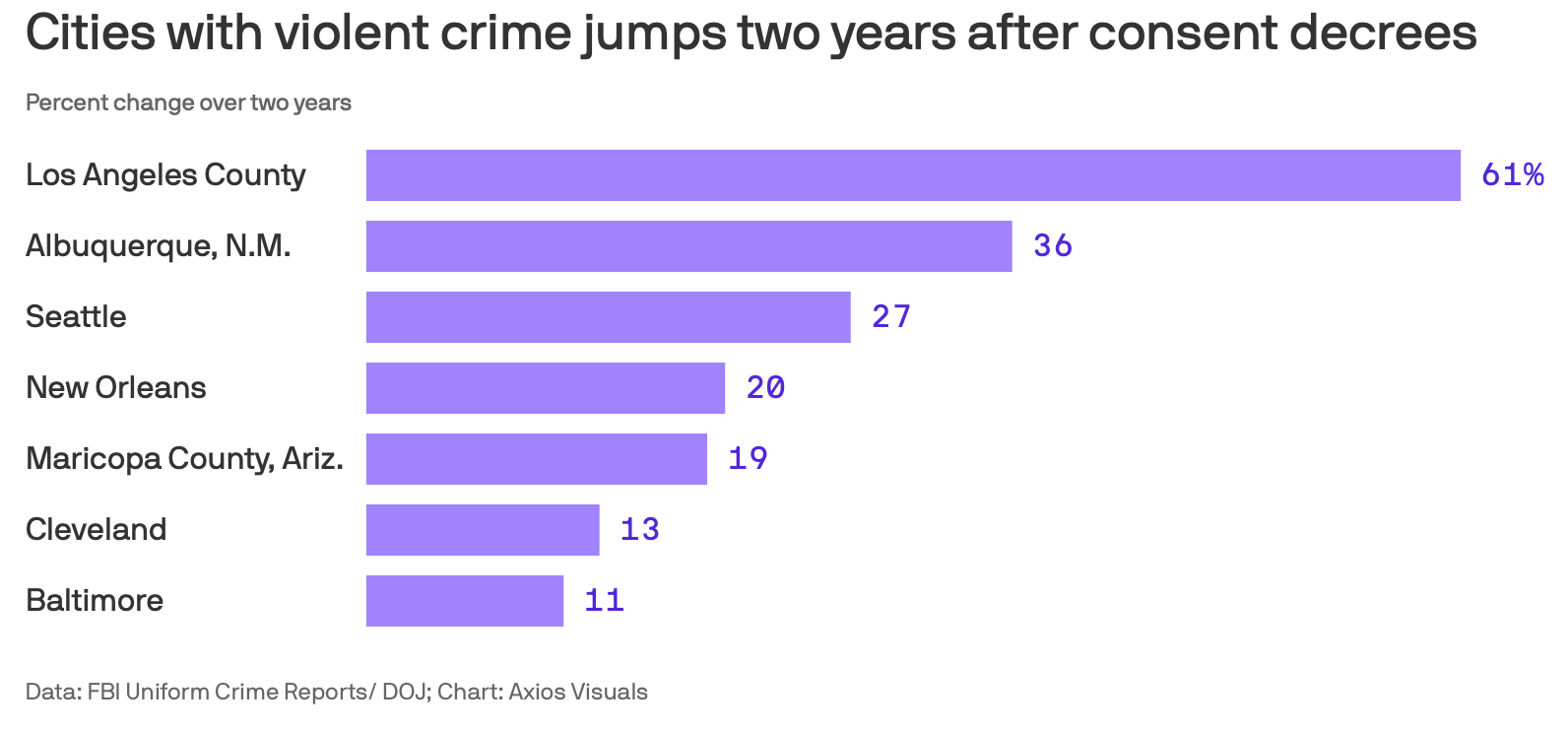
While it is often referred to as the “criminal justice system,” criminal justice in the U.S. is managed by hundreds of autonomous systems that vary on the federal, state, county, and even municipal level. That being said, the federal government has been exerting more and more influence through the Department of Justice. It does this through persuasion and threats of future action (DOJ calling on all states to eliminate all fines and fees in juvenile cases), free federal funds ($3.7 billion in discretionary grants for “accountable crime prevention,” but with strings attached), and consent decrees (exerting pressure on state or local agency to agree to federal oversight). Of course, none of this necessarily leads to better outcomes. Of the 12 police agency federal oversight consent decrees over the past decade, 7 experienced significant increases in violent crime within two years.
Beyond these methods, the DOJ can use its civil rights division to simply order states to reconfigure their entire prison system. That happened on Tuesday, when the DOJ “blindsided” the Utah department of corrections with a ruling in a discrimination case involving a transgender inmate. The ruling, which has its own press release, will impact prisons, jails, and inmates across the US. Following a number of complaints from a biological male inmate who claims to suffer from gender dysphoria, the DOJ has determined that the American with Disabilities Act applies to all inmates with gender dysphoria. Accordingly, the Utah DOC must 1) provide prompt and direct access to hormone treatment: 2) cannot impose certain eligibility criteria for assessment and treatment; and 3) must reasonably modify policies, practices, and procedures to avoid discriminating against an individual with the condition.
So, what does this all mean? In its ruling, the DOJ adopts a standard that requires a streamlined procedure to approve hormone therapy and lab testing to ensure proper dosing and impact with other prescription medications. Further, the DOJ requires the Utah DOC to make changes to all of its policies and procedures to allow the individual to live “consistently with her gender identity.” Specifically, it found that all of the accommodations requested by the individual were reasonable, including:
provision of female clothing
allow for purchase of bras, women’s underwear, and makeup from the commissary
require that all pat searches and visual searches of the individual are not conducted by male correctional officers
transfer the individual to female housing
The DOJ expects the Utah DOC to revise all of its relevant policies, practices, and procedures, provide the requested accommodations, train all personnel on the new rules, provide the federal government with access to all facilities and files regarding these steps, and pay compensatory damages to the complainant. (This would presumably include damages for complainant’s self-mutilating double orchiectomy, which the DOJ describes as “complainant performed dangerous self-surgery and removed her own testicles.”)
The DOJ seeks to enforce this ruling through a consent decree or federal lawsuit. While there are many issues left to be considered (including conflicting laws in numerous states), the DOJ will certainly expects all prisons and jails in every jurisdiction to comply with these recommendations. For now, the Utah DOC “fundamentally disagree[s] with the DOJ on key issues, and [is] disappointed with their approach.”
Oh, Canada: Last Friday, the Canadian Supreme Court ruled that it was “problematic” for a lower court to refer to the victim of a sexual assault case as a “woman.” The Court suggests that the proper term should be “person with a vagina.”
The Canadians are very serious about “problematic” things. The attorney general says it is very, very important that the government have the power to punish someone it believes might commit a hate crime even if they haven’t actually committed any crime. The proposed pre-crime bill also establishes a new hate crime offense which would carry the maximum penalty of a life sentence. But don’t worry, the justice minister says the life sentence wouldn’t follow for “mischief to a garage door,” but it would give any “judge a wonderful range of sentences.”
The Kids of Rutherford County: If you have the time, this four-part podcast from the makers of Serial documents the juvenile justice system in Rutherford County, Tennessee. For over a decade, the county arrested and illegally jailed hundreds, maybe thousands, of children. The podcast details how it happened and what it took to stop it.
Stronger: 6 US senators have co-sponsored the federal “Stronger” act which updates and reauthorized the substance abuse treatment act for state prisoners. Updates to the act include funding through 2029 and:
Allowing grantees to use RSAT funds to offer treatment to individuals pretrial;
Strengthening the requirements that all treatment services adhere to established clinical standards;
Ensuring programs are affiliated with providers who can ensure continuity of care and access to medications after release to reduce the risk of relapse and overdose deaths;
Requiring program staff to be trained on the science of addiction, strategies for continuity of care during and after incarceration, and evidence-based behavioral therapies used to treat substance use disorder;
Building capacity, where available and appropriate, including assisting prisons and jails to meet contemporary standards of medical care for substance use disorders;
And allowing grantees to use funds to obtain training in best practices for treating substance use disorders. The bill does not include any unfunded mandates for training or otherwise.
The Act does not consider treatment with the GLP-1 diabetes/weight loss drugs (Ozempic, Trulicity, Rebelsus), which have been found to produce a significant decrease in alcohol use disorder.
Freedom in Massachusetts: Governor Healey has announced sweeping pardons for marijuana possession cases across Massachusetts. The mass pardon could affect hundreds of thousands of individuals.

Big city, big problems: The police chief in Houston has apologized for failing to investigate a number of incident reports over the past 8 years due to lack of personnel. The incidents not investigated include violent crimes, sexual assault, and property crimes. All told, about 264,000 reports were dropped without investigation.
Unreform in D.C.: Mayor Bowser has signed a sweeping new crime bill for the nation’s capital that reverses much of the George Floyd era reforms. The bill is designed to combat the crime crisis across the city and “rebalance that public safety ecosystem that has changed over the last 10 years, and we’re starting to swing it back to the right place.” The new law includes stronger gun penalties, cracks down on organized theft, and expands the definition of carjacking. It also creates drug-free zones and allows for the collection of suspects’ DNA if they’re charged with a violent or sex crime.
Bad, good, bad?": Sheldon Johnson spent 25 years in prison for attempted murder. Since his release, the 48-year-old had spent his time working with the Queens Defenders office in New York, talking about his efforts to reform himself and helping kids detach themselves from gang life. He appeared on the Joe Rogan podcast in February to discuss his criminal justice activism and how he turned his life around. He was arrested this month after a wellness check led to the gruesome discovery of a man he allegedly killed and dismembered in an apartment. Officers found a human torso and a foot in a plastic bin.
Police officials said a concerned neighbor reported hearing gunshots from the unit and saw a man coming and going from the building multiple times through the night, carrying various cleaning supplies. Surveillance footage from outside the apartment's front door allegedly showed him carrying cleaning items as well as a full black garbage bag.
Stuff of the Week
Bernie at the bank: Two women drove a dead man’s body to the bank to withdraw his money before taking the body to a hospital. They were charged with gross abuse of a corpse and theft.
Low risk: A Las Vegas man arrested for robbery, shooting at two people and killing two dogs is granted bail because he was deemed “low risk” by a pretrial assessment tool. Five days later he was charged with ditching his ankle monitor and stabbing a woman.
Yoko: A hardcore singer is accused of dosing his band member with estrogen to steal his fiancee.
They are watching you, part 77: An error message on an M&M branded vending machine on a college campus has revealed that the machine has been covertly collecting facial-recognition data on customers without their consent.
They are watching you, part 78: GM, Honda, Kia, and Hyundai have been caught providing driver data (mileage driven, start and end times for any trips, acceleration, and braking) to insurance companies without driver consent.
Hide the stuff: Police in Massachusetts searched a suspicious truck during a traffic stop and found cocaine. They also found an M190 U.S. Army rocket launcher during the traffic stop. Apparently, the driver was “pretty vague” about how he got it.
Shai-Hulud: Scientists have discovered a super worm in Chernobyl which is immune to nuclear radiation and may have the ability to repair its DNA.